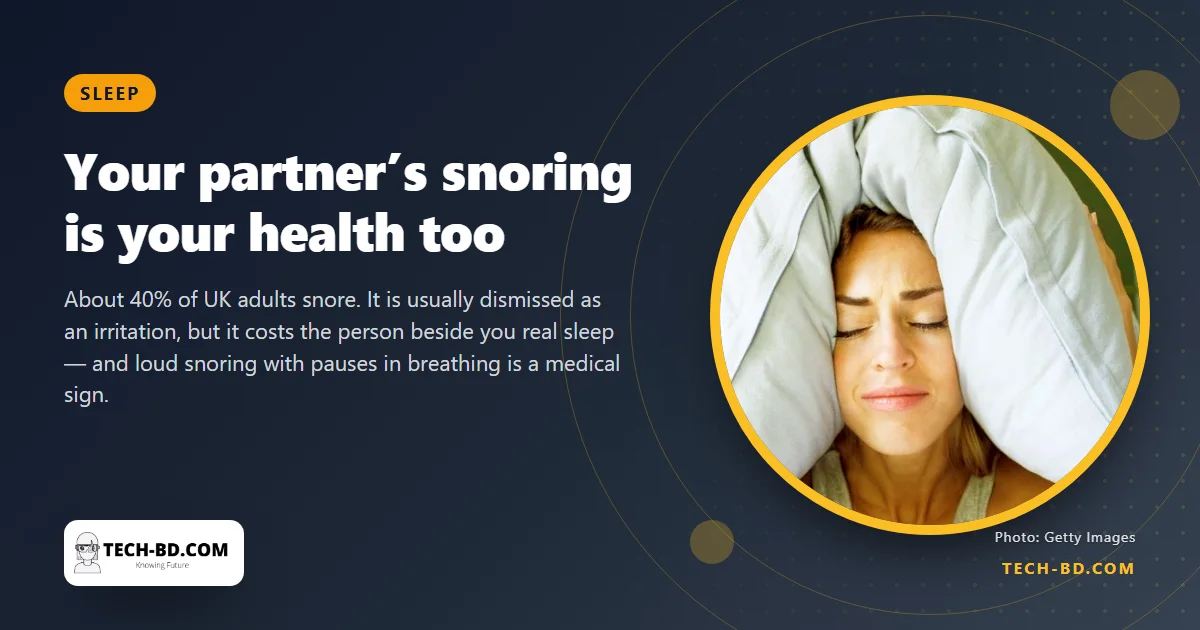
Have you ever slept next to a snoring partner and woken up stressed, unfocused or forgetful? Snoring is common enough that it is usually written off as a harmless irritation. Experts say sleeping next to a snorer can affect your health.
What snoring is
Snoring is caused by the vibration of the soft tissues in the upper airway during sleep, explains Dr Clare Simon, a dentist with a special interest in dental sleep medicine. When the muscles relax, the airway narrows, and air moving through it makes the surrounding tissue vibrate.
About 40% of the UK adult population snores, affecting more men than women, according to the British Snoring and Sleep Apnoea Association. And 75% of people with a snoring partner say their sleep has been affected, according to a US survey by the Sleep Foundation.
The part worth acting on
There are two quite different situations here, and confusing them is the reason people put up with it for years.
Simple snoring is a noise problem: annoying, disruptive to whoever is nearby, but not in itself dangerous to the snorer. Obstructive sleep apnoea is a medical condition, and the signs are specific — loud snoring punctuated by silences where breathing stops, gasping or choking sounds, and daytime sleepiness severe enough to fall asleep watching television or, dangerously, driving.
Untreated apnoea is associated with high blood pressure, heart disease, stroke and type 2 diabetes. It is also very treatable. The person best placed to notice it is almost never the patient — it is the person lying next to them, which is why this is worth raising rather than enduring.
What it means in Bangladesh
Sleep medicine barely exists as a specialty here. There are a handful of sleep labs, almost entirely in Dhaka and private, and the great majority of Bangladeshis with sleep apnoea will never be diagnosed with it.
That matters more than it sounds, because the risk profile in Bangladesh is rising fast. Apnoea tracks with weight and with neck circumference, and urban Bangladesh has seen a sharp increase in both overweight adults and type 2 diabetes — which runs in both directions with apnoea, each worsening the other. A country with one of the world's highest diabetes burdens has a correspondingly large undiagnosed apnoea burden underneath it.
Three things are worth knowing. If someone in your household snores loudly and stops breathing in their sleep, that is not a joke to be repeated at breakfast — it is a symptom, and it is worth a doctor. Before anything expensive, the interventions with the best evidence are unglamorous: weight loss where relevant, sleeping on the side rather than the back, avoiding alcohol and sedatives before bed, and treating nasal blockage.
And for the partner: your broken sleep is a real health cost, not a complaint to be embarrassed about. Sleeping in another room while the underlying problem is investigated is a reasonable, temporary, medical decision — and in the households where that is impossible, which is most of them, it makes getting the snorer assessed more urgent rather than less.