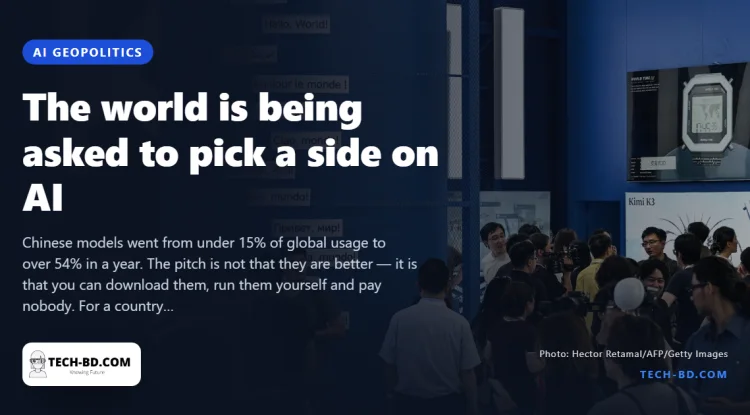
The United States has ordered all artificial intelligence technology from the Chinese firm DeepSeek removed from most government systems. The Department of Homeland Security has banned its use within civilian agencies — and any technology built with the aid of its AI models.
The scope, and the date
The order applies to civilian agencies including the Treasury, the State Department and the Department of Justice. Agencies within the Department of Defense are excluded. The DHS made the order public on Monday, but it took effect at the end of July — meaning it had been operating for nearly three months before anyone outside government was told.
The notice did not detail the exact security concerns. DHS, DeepSeek and the Chinese embassy in Washington were approached for comment.
Why the second clause is the hard one
Banning an app is simple. Banning “any technology built with the aid of its AI models” is not, because DeepSeek is open source — free to access and cheaper to run — and American companies have built it into things they sell. Snowflake, Vercel and OpenRouter all incorporate DeepSeek in their customer offerings. Startups have flocked to open models generally.
A procurement officer now has to establish not only what a vendor’s product is, but which models it was trained or built with — a question most contracts have never asked and most vendors cannot answer cleanly. That is the part of this order likely to cause the most work.
The cost argument that made DeepSeek matter
For a developer, using DeepSeek costs a fraction of a closed model such as Google’s Gemini, Anthropic’s Claude or OpenAI’s Codex. And what DeepSeek spent to build its models has been astronomically less than the American firms spent on theirs: the company said it took about $6m to train the debut version.
That number is why the ban is a trade story as much as a security one. The firm has grown rapidly since its 2025 release, with demand heavy enough to take its servers down at times, and its free chatbot is among the most downloaded apps in Apple’s rankings.
The political frame is explicit. White House tech lead Michael Kratsios wrote in an internal memo this year that “malicious exploitation” of American AI firms had been occurring, mainly by rival firms in China. Anthropic and OpenAI — both heading for stock market listings — have claimed their models were essentially copied by Chinese firms, DeepSeek among them.
What this means for a developer in Dhaka
Nothing legally. The order binds US civilian agencies, not Bangladeshi companies, and open models remain open. But two practical consequences follow.
First, if you sell software to clients who hold US government contracts — and a good deal of Bangladesh’s outsourcing work sits somewhere in that supply chain — expect to be asked which models are inside your product. The honest answer requires knowing, which means keeping a record of the models and versions a product depends on. That is a five-minute document today and an awkward email later.
Second, the cost gap is real and it is why open models matter here. A Dhaka startup that cannot pay frontier-model prices can build on an open model and ship. The risk is not that this becomes illegal; it is that the open option becomes commercially awkward in export markets, which is a reason to design so the model can be swapped rather than welded in.