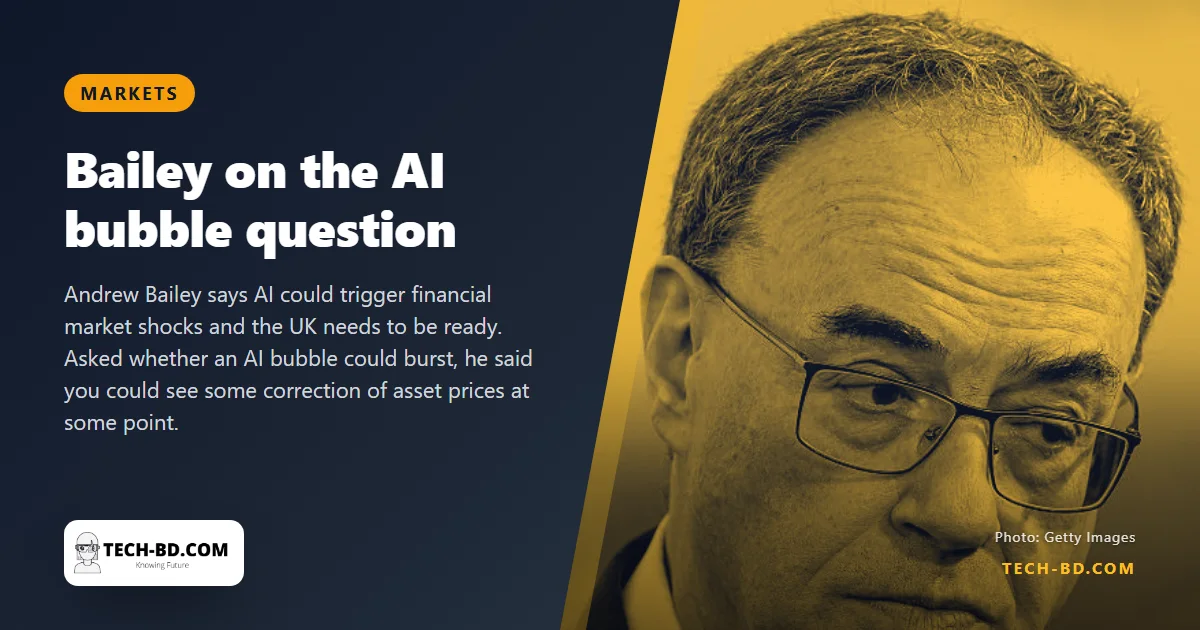
Artificial intelligence could trigger financial market shocks and the UK needs to be prepared for them, the governor of the Bank of England has warned.
What he said
Andrew Bailey said the central bank is watching the huge amounts of money being invested in AI "very carefully", and cautioned that "not everybody always wins".
The money spent on and lent to AI firms over recent years, in the hope of large returns, has pushed markets to value some of them as multi-trillion-dollar businesses. Asked directly whether an AI bubble could burst, Bailey said: "You could see some correction of asset prices at some point."
He was speaking to the BBC about the risks and benefits of AI for the UK economy. In a separate interview the same week, Bailey also argued that regulating AI is "not the right place to start" — a position worth holding alongside the warning, because it tells you he sees the risk as financial rather than technological.
What it means in Bangladesh
A central bank governor saying "correction" is doing something specific: not predicting a crash, but declining to rule one out. That distinction matters, and it is the part usually lost in the retelling.
Bangladesh has no direct exposure to AI equities. Almost nobody here holds Nvidia or Microsoft stock, the DSE lists nothing comparable, and the country's institutional investors are not in that market. If AI valuations halved tomorrow, no Bangladeshi portfolio would feel it directly.
The exposure is second-order and it runs through two channels. The first is the cost of money. A large repricing in US equities moves capital into government bonds, changes what the Federal Reserve does next, and resets the rate at which every emerging economy borrows. Bangladesh's external debt service is already the fastest-growing line in its budget; it moves on decisions taken in New York, not Dhaka.
The second is the pipeline of cheap tools. A great deal of what Bangladeshi developers and small businesses use today — generous free tiers, subsidised API pricing, models given away to win market share — exists because investors are funding growth over profit. That is a bubble-era subsidy whether or not anyone calls it one. If the money tightens, the first thing to change is not the technology; it is the price of access to it.
The practical implication for a Bangladeshi firm building on these services is narrow and worth acting on: know what your product costs at list price, not at the promotional rate you are paying. A business whose margin depends on a free tier has a strategy that belongs to somebody else's investors.