It took $4-a-gallon petrol to make American buyers embrace hybrids. With little on offer from Detroit, they went to the Asian carmakers instead.
The quarter
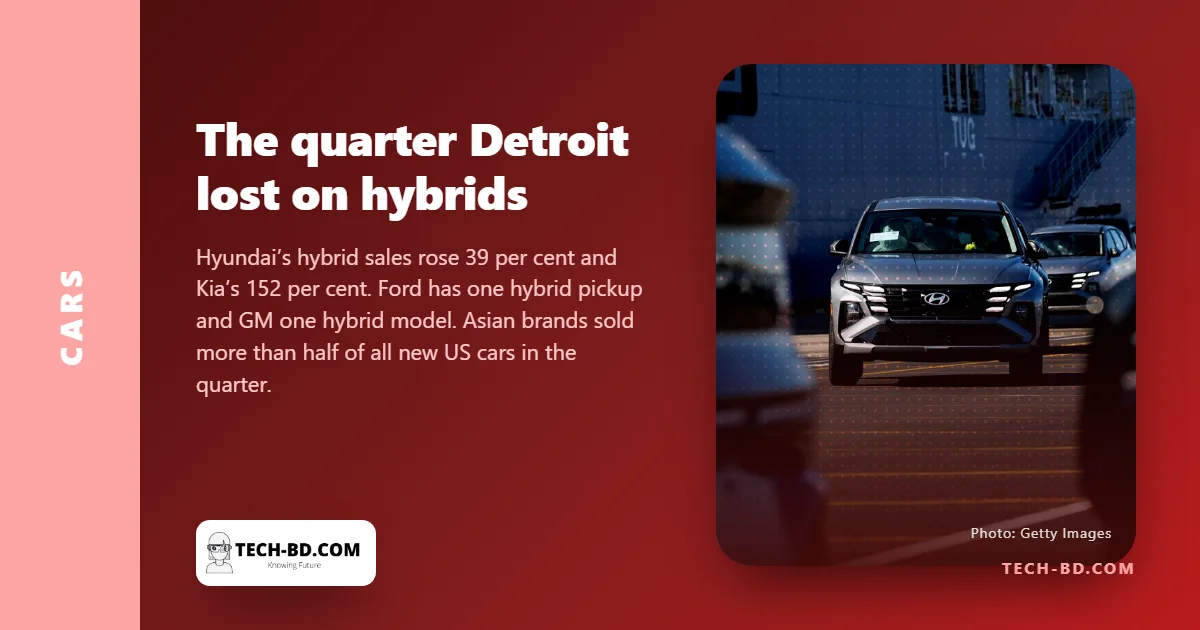
Hyundai's hybrid sales rose 39% in the third quarter and Kia's more than doubled, up 152%. Toyota's hybrid sales rose 29% and Honda's 21%.
Hyundai and Kia together sold 506,200 vehicles, within four thousand of Ford's 509,764 — close to taking third place from an American carmaker for the first time. Asian brands sold more than half of all new cars in the quarter, according to Cox Automotive; US companies recorded a record-low share.
Detroit's cupboard is nearly bare. Ford sells one hybrid pickup, the Maverick, and discontinued the hybrid Escape. GM has a single hybrid model — a version of the Corvette. Stellantis is phasing out plug-in hybrids in North America.
Pure electric sales, meanwhile, fell: they cost more, and the $7,500 buyer credit ended last September. Tesla's quarterly sales were down 2%.
"It just stresses how important it is to have the right product at the right time, but you can't predict that nearly as well as you would like," said Edmunds' Ivan Drury.
What it means in Bangladesh
The story is not really about hybrids. It is about what happens to a manufacturer whose product range assumes a fuel price that no longer holds — and that question has a Bangladeshi version.
Detroit spent two decades deleting small cars and efficient sedans to build high-margin trucks, which was the right commercial call for twenty years and the wrong one for this quarter. Reversing takes years, because a model line is a factory, a supplier contract and a trained workforce, not a decision.
Bangladesh does not build cars, so the exposure sits elsewhere: in the import and assembly business, and in the enormous installed base of CNG conversions. The country already made one version of this bet successfully — the mass conversion of three-wheelers and cars to gas in the 2000s, which was ahead of the world on cheap domestic supply. It worked until the gas stopped being cheap and domestic, which is roughly now.
What follows is a genuine opportunity and worth stating as one. Bangladesh's vehicle fleet is young in the sense that most of it has yet to be bought. The reconditioned-import channel that supplies most private cars already sources heavily from Japan, where hybrids are ordinary rather than premium. The duty structure, not the market, is what decides whether a Dhaka buyer can reach one.
That makes this a tax question rather than a technology question. A hybrid import regime set now determines what the fleet looks like in 2040, and whoever sets it is making a long bet on the price of a litre.
The European side of the same squeeze is in the Dagenham story.