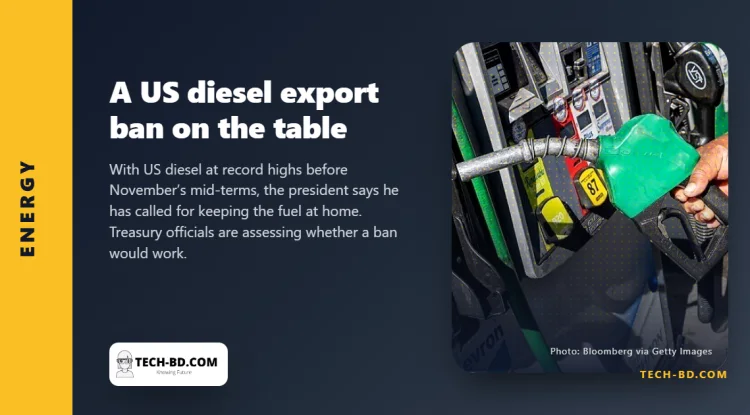
As the Trump administration deliberates over historically high gas and diesel prices, a growing number of US states are acting on their own — red, blue and purple alike.
What the states are doing
Ohio became the latest on Thursday, suspending its gasoline tax of 38.5 cents a gallon and diesel tax of 47 cents for 90 days, at an estimated saving to drivers of $725m. Georgia declared a state of emergency and paused its levies for a month; Indiana extended an existing pause; Kentucky and Illinois acted earlier in the year.
Gas is above $4.40 a gallon nationally — never this high at this point in the year, not even after the invasion of Ukraine. Diesel hit an all-time high last month.
What the analysts say
Drivers typically receive only 60 to 80 per cent of the savings from a fuel tax holiday, said Alex Arnon of the Penn Wharton Budget Model; the rest is captured by stations and others along the supply chain. In today's conditions he expects the lower end.
"Everybody along the supply chain has both an incentive and more opportunity to siphon off a little bit of the savings," he said.
Patrick De Haan of GasBuddy put the deeper objection: cutting the price only raises demand without adding supply. "The market is telling you it's in distress," he said. Andy Lipow of Lipow Oil Associates was blunter: "If you want to lower prices, end the Iran conflict."
Decades of the same experiment, never measured
This is the most directly transferable piece of evidence in this week's news, because Bangladesh has been running the experiment for decades without measuring it.
Every Bangladeshi government has used fuel pricing as a social policy instrument — holding the pump price below cost through BPC, then correcting in painful jumps. The question Penn Wharton answers is the one nobody here asks: when you cut the price at the pump, who actually receives the money?
Their finding is that between a fifth and two-fifths of it never reaches the driver in a competitive American retail market with thousands of operators and published prices. There is no reason to expect a better ratio in Bangladesh, where retail margins are administratively set, supply is concentrated, and the dealer's incentive at a controlled price is to manage volume rather than compete.
De Haan's point is the harder one and applies with full force here. A subsidy that lowers the price without adding a litre of supply increases consumption of an imported product — which widens the import bill and pushes on the taka, so the saving is partly recovered through the exchange rate from the same households.
None of this argues for letting prices run free in a country where a diesel spike reaches the price of rice through irrigation pumps and trucks. It argues for the thing Bangladesh has never built: a measurement of where subsidy money lands. A targeted transfer to irrigation and bus operators is auditable. A price cut is not.
The farm-side version of this pressure is in the US farm belt squeeze.