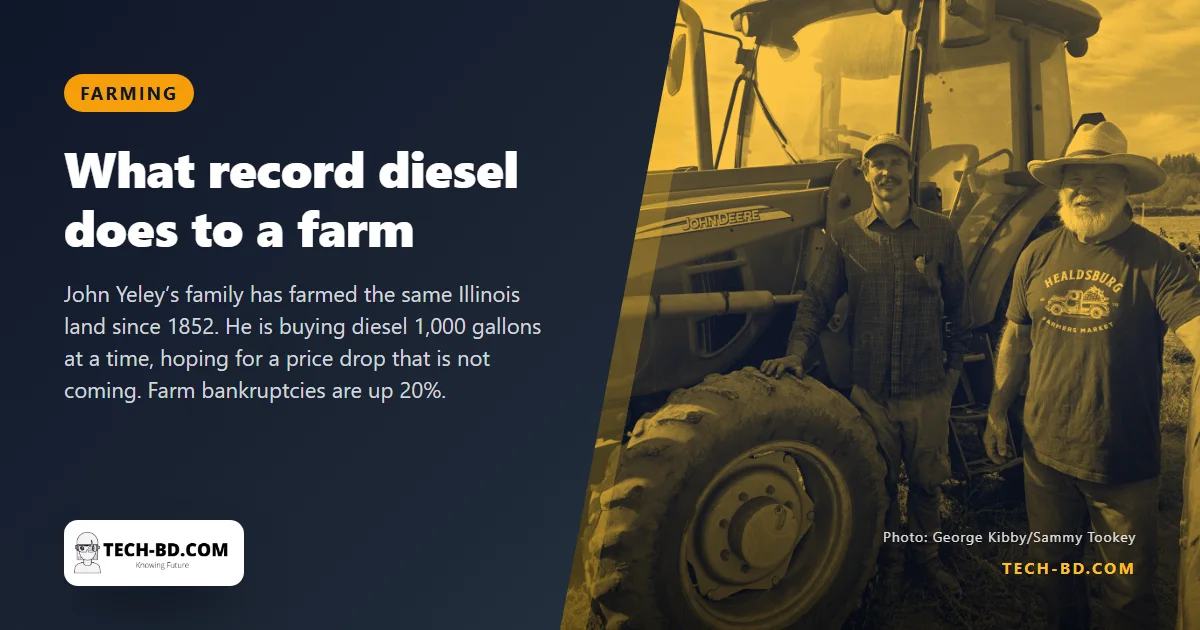
John Yeley is the seventh generation to run his farm in Illinois, which his family has owned since 1852. He plans to keep going. He is no longer sure he wants his 16-year-old son and 12-year-old daughter to take over. "Right now, the way all of this is now, no, I wouldn't wish it on them."
The arithmetic
Diesel is the most pressing problem. The US national average has risen faster than petrol and sits near its all-time high of $6.53 a gallon; in Illinois it was $6.82. Yeley normally buys 8,500 gallons twice a year. "This is the first year in my adult life that we have not bought an entire transport load… We've been buying it piecemeal, 1,000 or 1,500 gallons at a time, hoping that we'd see a price drop. Unfortunately, it's not happening."
Fertiliser is up as much as 50% in a year — first because Russia's war with Ukraine cut off raw materials, then because the war in the Middle East cut off exports. Interest rates on the short-term loans that carry a farm from planting to harvest are higher. Trade disputes have closed markets, particularly for soybeans.
Farm bankruptcies rose 20% in the twelve months to June. "A lot of these farmers are on the edge," says attorney Tom Ajamie. "It's a 20% increase right now, but what happens in the next two, four, five months?"
Some legislators have pressed for a ban on US diesel exports; many energy experts doubt it would lower prices.
What it means in Bangladesh
This is the same shock Bangladeshi farmers are absorbing, arriving through the same two inputs, and the Bangladeshi version is harsher in every respect that matters.
Diesel runs the irrigation pumps that make boro rice possible, and boro is roughly half the country's rice. The season runs from December, which is precisely when a supply squeeze building through the northern winter will land. Unlike Yeley, a Bangladeshi farmer cannot buy 1,500 gallons and wait — the holding is a couple of acres and the cash comes from the last harvest or from a loan.
Fertiliser is the sharper difference. Bangladesh imports most of its urea, TSP, DAP and MOP, and the government absorbs much of the world price through subsidy. That has held the farm-gate price far below what Yeley pays — and it means the shock lands on the national budget instead, competing with everything else, and it means the adjustment when it comes is a policy decision rather than a market one.
The credit point transfers exactly. Yeley's neighbours went under because they borrowed to plant and could not repay. The Bangladeshi equivalent is the informal lender charging monthly rates, because agricultural credit reaches a minority of smallholders. A season of high input costs does not merely reduce a Bangladeshi farmer's income; it moves the household onto terms it cannot escape.
And the succession question is the one that should worry policymakers most, because Bangladesh has it too, unmeasured. Yeley does not want his children farming. Across rural Bangladesh the same conclusion is being reached quietly, and it shows up as migration to Dhaka rather than as a statistic.
The fuel side of this is set out in diesel back at record levels, and the policy response in the US export ban on the table.