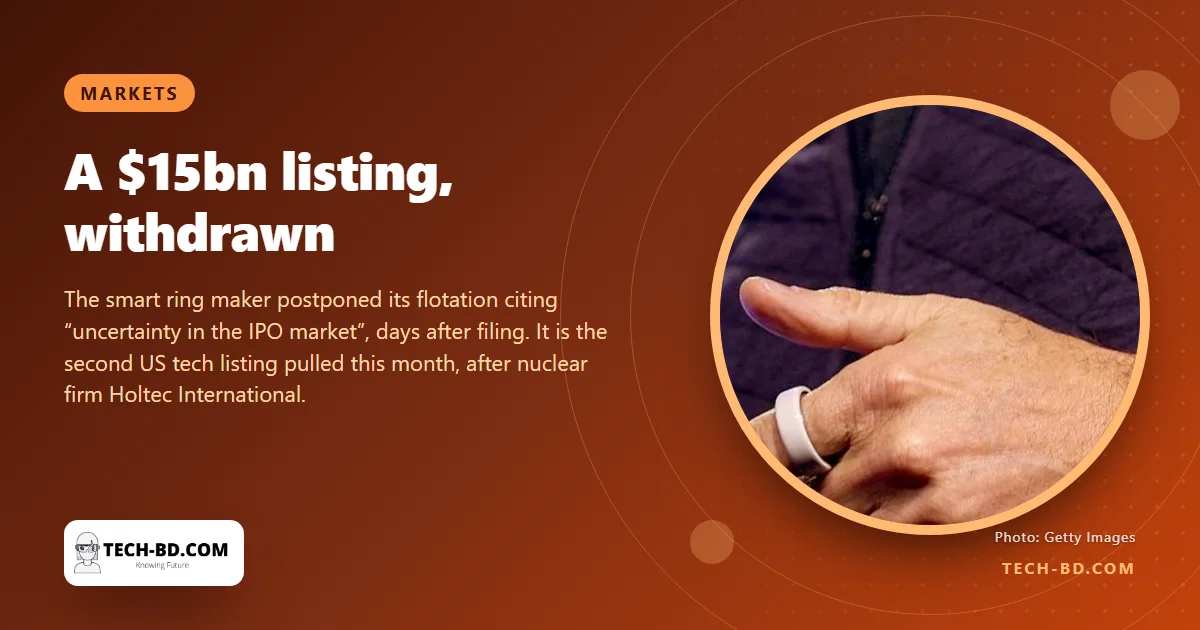
Oura has pulled its plan to sell shares on the US stock market — a listing that would have valued the firm at $15bn (£11.3bn) — just days after announcing it.
What happened
The maker of smart rings that track their owners' health said it would postpone the flotation "due to uncertainty in the Initial Public Offering (IPO) market", and did not say when it might go ahead. It had filed official documents setting out plans to raise up to $2.2bn just over a week earlier.
Chief executive Tom Hale said "an IPO is just one step in our journey", adding that "we have the luxury of choosing our moment".
Oura is the second to delay this month. US nuclear technology firm Holtec International also postponed its flotation, blaming an "unusual confluence of developments that has impaired investor confidence in the market for new public offerings".
The pattern worth noticing
Two withdrawals in a month, in unrelated sectors, alongside Anthropic and OpenAI both preparing enormous offerings. That combination usually means one thing: investors are still willing to fund the story everyone is excited about, and are becoming choosier about everything else.
A health wearable at $15bn is a good business asking to be valued like a technology platform. In a confident market that argument lands. In a nervous one it does not, and a company with the cash to wait withdraws rather than price low and carry the mark.
What it means in Bangladesh
No Bangladeshi investor could have bought these shares, and the direct relevance is nil. The indirect relevance is not.
A cooling IPO market is the first visible stage of venture capital becoming cautious, because the public listing is how early investors eventually get their money back. When that exit looks uncertain, the funds behind it slow down — and the effect travels outward from Silicon Valley to the periphery, arriving last and hardest at the smallest markets.
Bangladesh's startup sector is already thin on late-stage capital, and the handful of local companies that have raised meaningful foreign rounds did so in a period of cheap money that has ended. The practical consequence for a Dhaka founder is not that valuations fall — it is that the time between rounds gets longer, and the terms get harder. Companies that planned on eighteen months of runway and a friendly raise are the ones that get caught.
There is also a reading for the Bangladeshi market itself. The DSE has struggled for years to attract technology listings, and the standard explanation is regulatory friction. This story is a reminder that even in the deepest capital market on earth, a good company with a real product can find the window shut. Timing is not a Bangladeshi problem; it is the nature of public markets.
The far larger listing being prepared in the same climate is in Anthropic's leaked prospectus.