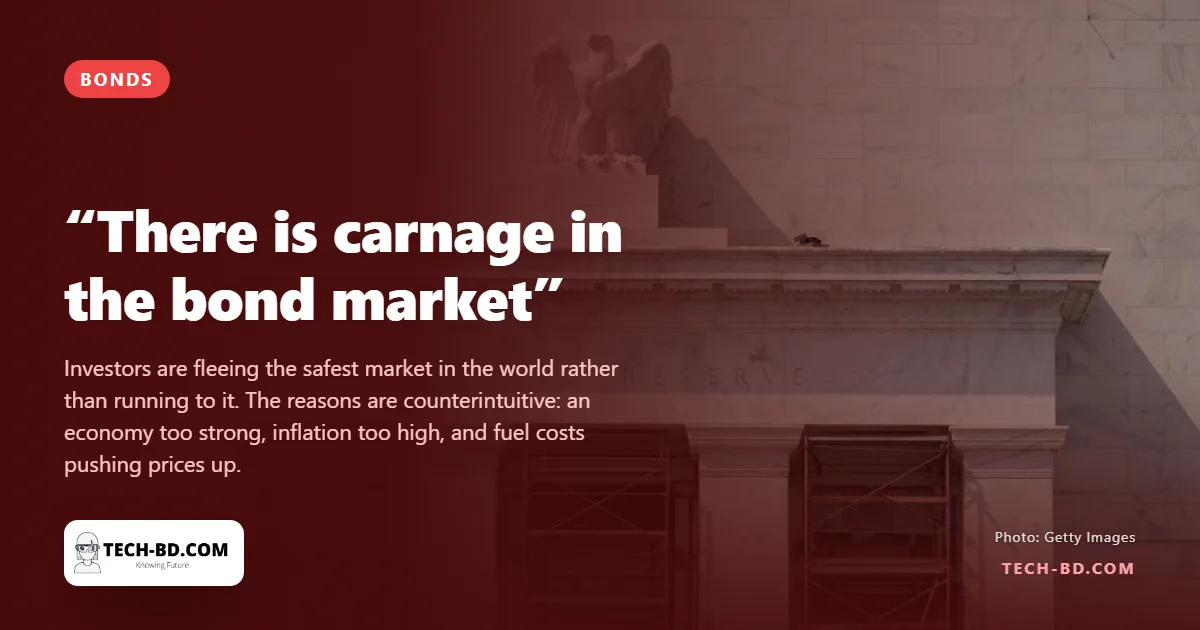
The bond market is in an unrelenting sell-off. The yield on the 10-year US Treasury note has hit its highest level since the dot-com bust.
Why that is strange
American government bonds are the world's most important financial market and are widely considered the safest place to park money. When times are tough, traders normally flee into them. That is the opposite of what is happening.
The 10-year yield hit 5.34% on Thursday, its highest since 2002, before ending the day at 5.24%. The 30-year Treasury reached 5.69%, a 24-year high. "There is carnage in the bond market," said Neil Wilson, strategist at Saxo. "The worry is that US growth is way stronger than expected."
The causes are counterintuitive. The US economy is strong — probably too strong, supported by massive AI spending. Inflation is too high, with prices pushed up by rising fuel costs. The Federal Reserve raised its benchmark rate last month for the first time since 2023 and may go again. Debt concerns weigh too, with government spending from both parties on an unsustainable path.
It is not only American. The 30-year UK gilt hit 6% for the first time since 1998; the French 10-year reached 4.95%, its highest since 2002. The rate on a 30-year US home loan topped 7% for the first time since early 2025.
What it means in Bangladesh
This is the mechanism the Bank of England governor was gesturing at, visible in numbers. And unlike an equity sell-off, this one reaches Bangladesh directly.
The 10-year Treasury yield is the reference price for risk worldwide. When it rises, every other borrower pays more — not because their own position changed, but because the risk-free alternative got better. For Bangladesh that shows up in three places: the coupon on any new sovereign borrowing, the cost of rolling over existing external debt, and the pricing of commercial project finance, which is where the infrastructure pipeline sits.
The currency channel is the sharper one. Higher US yields pull capital toward the dollar, and a stronger dollar raises the taka cost of every import — fuel, food grain, capital machinery, industrial raw material — without any domestic decision being taken. Bangladesh Bank then faces the familiar choice between spending reserves and letting the rate move.
One detail deserves attention because it closes a loop. CNN attributes part of the inflation driving these yields to rising fuel costs, and bondholders demanding compensation for "the effects of higher gas and diesel prices on their investments". The Strait of Hormuz is therefore not only in Bangladesh's import bill; it is in the interest rate Bangladesh will pay on its next loan. Those are usually treated as separate stories. They are one.