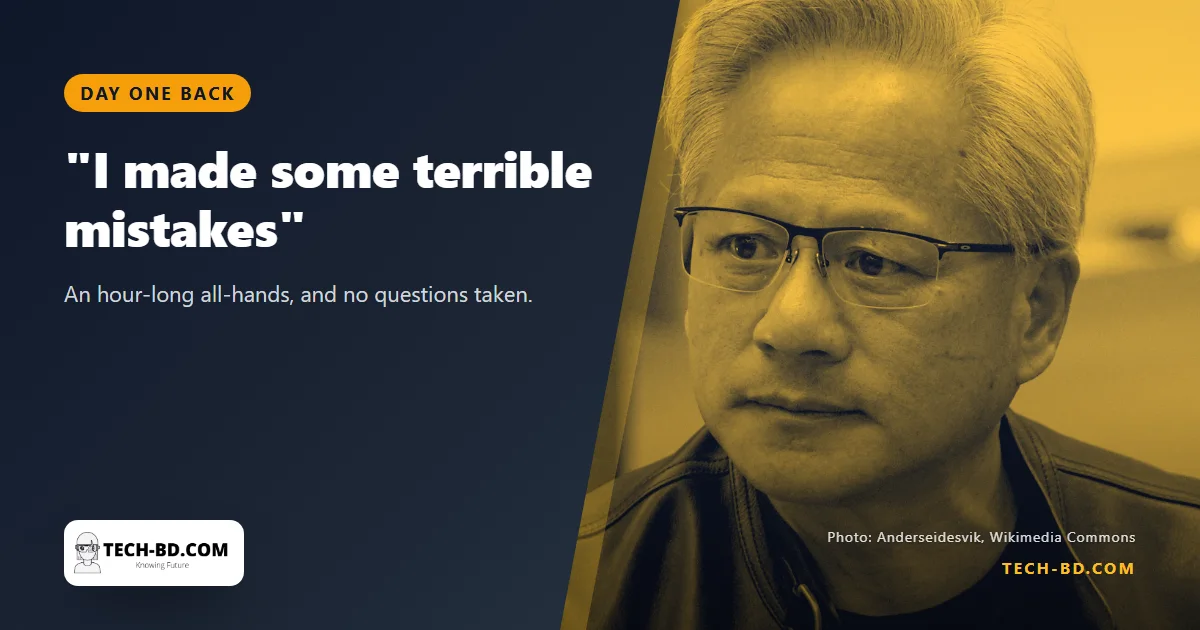
Jensen Huang apologised to Nvidia employees in an hour-long company-wide meeting on Tuesday, according to a source familiar with the meeting — one day after being reinstated as chief executive of the company he founded three decades ago.
He resigned on 12 November after two relationships were reported: one with a subordinate at the company, and one with a woman whom US officials believed to be working for Chinese intelligence. The board reversed its position on Monday, which we covered in our report on the reinstatement.
What he told the company
Huang said he had resigned because he broke the company's code of conduct — and that coming back does not place him "above the code of conduct".
He went further, in a way that was presumably meant to be reassuring and will read differently to different people: breaking the code of conduct does not automatically mean a person is fired, and it is up to management to decide what happens in each case, just as the board did in his.
"I made some terrible mistakes," he said, according to the source. He said he had also apologised to his wife and children, and that he was thankful for a second chance. His two children, Madison and Spencer Huang, are executives at Nvidia, as is his son-in-law, Nico Caprez.
He told employees he is in therapy for more than an hour a day. The all-hands was one of the hardest meetings he had ever done, he said — though "the hardest meeting I've ever done was with my wife."
The part that was about the company, not the man
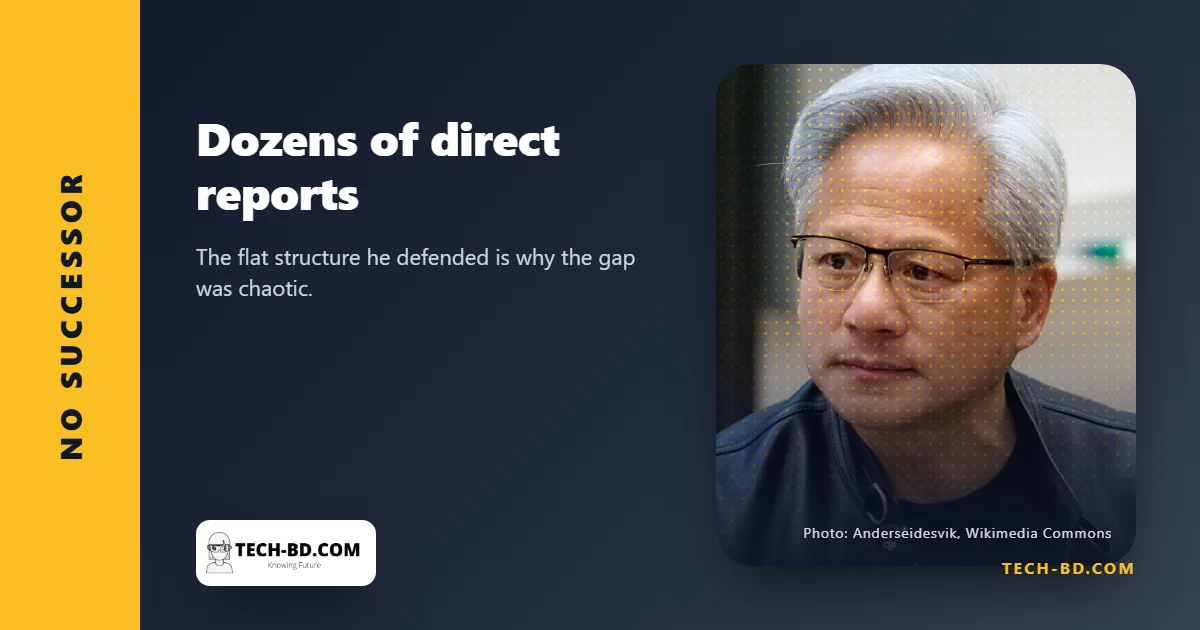
Huang also spent time defending Nvidia's unusually flat management structure, in which he has dozens of direct reports and no clearly defined successor. He said the structure reflects the breadth of the company's business and gives everyone an "equal say" with him.
That subject is not incidental. The absence of a successor is precisely what made the past two weeks so disorderly: during his absence, chief financial officer Colette Kress served as interim chief executive while the board considered its options.
He took no questions
The source said Huang took no questions. He did pause at one point to tell the people in the room with him: "I need your feedback, do you understand what I'm saying?"
That sentence is the meeting in miniature — a request for feedback, delivered in a format that could not receive any.
What it signals
For staff, the practical message is that the code of conduct is enforced at management's discretion, and that discretion now has a very public precedent attached to it. For everyone else, this was the first time Huang has spoken at length since returning.
The harder conversation is still ahead: he is due before Congress next week, where the questions will not be about therapy or management structure, and where he will not be able to decline to take any.
One detail is worth holding on to. Huang dismissed the idea that Trump orchestrated his return — on the same day the president was telling a television interviewer that he had appealed to the board personally and made the deal. Both accounts cannot be complete, and the gap between them is the thing Congress will be asking about.