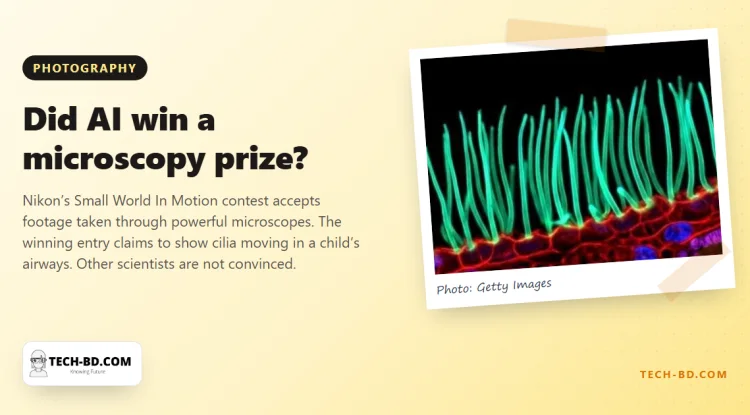
Nikon has disqualified the winner of its Small World In Motion contest, ruling that the use of generative AI in the composition of the video broke the competition's rules. The contest, which has run for 15 years, accepts photographs and video taken through powerful microscopes.
The entry came from Dr Ning Xu of Tsinghua University in China, and showed tiny hair-like structures called cilia moving in the airway of a child with the respiratory condition PCD. Xu had acknowledged using AI but said he believed he had acted within the rules, and cooperated with Nikon's investigation.
Nikon said the decision came "after thoroughly re-evaluating the video and supporting materials and consulting with members of our judging panel", and that the video "did not comply with the competition rules regarding generative AI". It added that this was not a judgement on the entrant's professional reputation or scientific contributions, and that it will now review the contest's rules and procedures.
The allegation itself, and why it was contested, is in the earlier piece. This is how it ended.
How it was caught, and why that matters
No detection software identified this. Scientists did, including former judges of the competition, who complained on Nikon's LinkedIn page that the video did not look real.
The most precise objection came from Dr Robert Hirst of the University of Leicester, lead scientist for an NHS PCD centre, who said he was "not surprised" and "knew immediately that the video was fabricated". His reason is the important part: "I have been diagnosing PCD for 20 years by examining their cilia waveform, length, cell size and shape."
He was not detecting AI. He was detecting wrong cilia — motion and proportions that do not occur in the condition he has spent two decades looking at. That is a different and far more durable skill than spotting a generative artefact, because it does not degrade as the models improve.
It also points at who can do it. A specialist with twenty years of a narrow subject can catch a convincing fake in seconds; a general-purpose detector cannot, and increasingly will not. Which means scientific integrity in the AI era depends on domain experts being asked, and on competitions building that into judging rather than relying on a declaration.
The part Nikon got right, and the part it did not
The ruling is narrow and careful. Nikon disqualified the entry for a rules breach without impugning the entrant's wider work, which is the correct scope for a competition organiser — it is not in a position to adjudicate anyone's research record, and it did not try.
What the episode shows about the rules, though, is that a declaration-based system fails quietly. Xu disclosed using AI and believed he was compliant; the judges passed the entry; the objection came from outside, after the prize. A rule that depends on an entrant's interpretation of where "enhancement" ends and "generation" begins will keep producing this outcome, and a review is the right response.
Why this reaches further than a photo contest
Scientific images are evidence. They appear in papers, in diagnoses, in teaching material and in grant applications, and almost none of those settings have a judging panel or a LinkedIn comment thread.
For a Bangladeshi university or journal the practical question is not how to detect generated images — that is not realistically winnable. It is whether submission rules require the raw capture and the acquisition metadata alongside the finished figure, so that a question can be settled by asking for the original rather than by arguing about pixels.
The parallel industry attempt to attach origin data to files is the C2PA standard now in TikTok, and for text, OpenAI's watermark.